
February Didn’t Kill Me!


A lived Whiskin’Dad Story
The Blink
My eyes were blinking fast—too fast.
The kind of fast that doesn’t feel frantic until you try to measure it against something familiar. I’d later compare it to the No. 3 Goodwrench car tearing around Daytona in 1998—wide open, no lift, pure momentum.
That was my body.
The room was loud. Focused. Urgent.
Nurses everywhere—scrubs moving with purpose, voices overlapping, all saying the same thing:
“King.”
"Mr. King.”
"Larry, look at me.”
I turned my head left and right, trying to give each of them my attention. My heart was pounding so violently I could feel it in my neck, in my ears—everywhere—as I glanced up at the monitor and watched the numbers climb past 200 beats per minute, like my heart was trying to run a race my body never signed up for.
And yet…
My mind was calm.
Not numb.
Not foggy.
Just… calm.
That disconnect should have scared the living daylights out of me.
My body was throwing up red flags like a legendary bad first date—the kind where she says everyone she’s ever dated cheated on her, takes zero accountability for any of it, and casually mentions her mom was a terrible person who cared more about pleasing men and obtaining alcohol than raising her kids… all while somehow making herself the victim in every single sentence.
Every warning sign imaginable.
Alarms blaring.
Systems screaming for help.
While my brain sat there quietly, convinced everything was under control.
Inside, I felt fine.
Relaxed.
Steady.
More curious than anything.
That’s the part no one tells you about dying—sometimes it doesn’t feel like chaos.
It feels like peace showing up way too damn early.
I was calm… and I was terrified as H-E-double-hockey-sticks—not because I felt like I was dying, but because everyone else in the room clearly knew something I didn’t.
Then there was Paul.
I remember him without effort. His voice cut through the noise—full of disbelief, but not rushed. Grounded. Strong. Like a father trying to get a stubborn son to understand something that matters.
“Brother, we need to put this oxygen mask on you ASAP. You’re losing oxygen fast.”
I looked up at him, genuinely confused.
“Sir,” I said politely, “I’m totally fine. I’m breathing just fine. I don’t need an oxygen mask.”
In my head, I was being reasonable.
Cooperative.
Present.
In reality, my body was betraying me.
I reached up—slowly, deliberately—to stop him.
Calm motion
.Calm tone.
“Sir, there’s no need for a mask.”
What I didn’t realize was that my movements weren’t smooth. My words weren’t clear. What felt controlled to me looked alarming to everyone else.
My mind was calm because it was running out of oxygen.
My body was failing while my brain was lying to me.
This wasn’t dehydration.
This wasn’t fatigue.
This was my systems shutting down one by one.
This was me dying.
(That sentence still hits like a punch to the chest.)
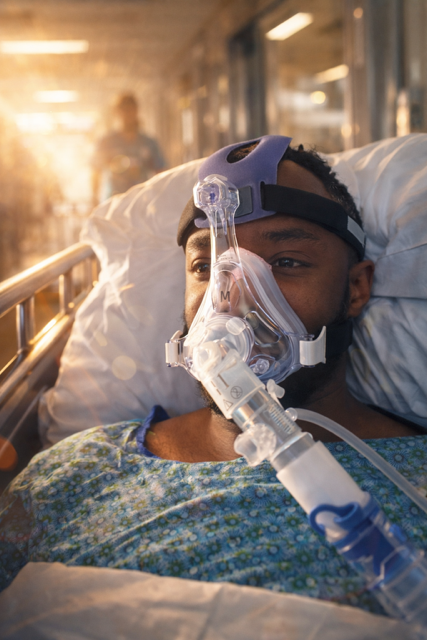
I was lying in an ICU bed at Good Samaritan Hospital in Puyallup, Washington, oxygen quietly slipping away while my brain kept insisting I was okay.
My body was failing while my brain was lying to me.
Paul’s voice sharpened.
“Brother, you are going to die if you don’t let me put this mask on you. Do you want to die? You’re too young. You’re too young, brother—please.”
That’s when Paul stopped asking.
“Get your damn hand out of the way. Let’s try to save your life.”
He was stronger than me—stronger than I realized I had become.
He moved my hand aside and pressed the mask down over my face.
And then—
Oxygen—cold, violent, overwhelming.
My lungs panicked. My chest fought it. My body unsure how to accept something it had been starving for far longer than my mind would admit.
It burned.
It shocked.
It demanded that I participate in my own damn survival.
I remember thinking—if I die tonight, it might be from this rush alone.
It took everything in me to stop resisting. To trust. To let my body catch up to the truth my mind had been avoiding.
That’s when I noticed the whiteboard on the wall.
Blue marker.
Neatly written.
February 2025.
My name.
My age.
The lead nurse’s name.
The time.
I didn’t know it yet, but this was the month that would split my life in two.

Strong Enough—Or So I Thought
Before that room.
Before the mask.
Before February split my life in two
I was in decent shape.
Better than decent, in my book.
Physically, I did what most men do when they’re trying to hold something together: I went to the gym. Every night after work. Free weights. Heavy ones. Very little cardio.
Men—we’re all familiar with this phase.
Arnold Schwarzenegger said it best in Pumping Iron back in 1977
“Milk is for babies. When you grow up, you drink beer.”
Which, in gym-language, basically means: cardio is optional, but the show muscles are mandatory.
So that’s what I trained.
Arms.
Chest.
Shoulders.
Muscles you can see in the mirror.
Muscles that quietly say, I’m fine.
And I was.
Until I wasn’t.
About five months before I was hospitalized, something shifted.
I stopped caring as much about how strong I looked and started caring more about how long I could last. I wanted endurance. I wanted my heart and lungs to work with me—not just my reflection.
So I started cycling.
Two hours on the bike at the gym. Nothing fancy—just an in-gym Lance Armstrong with none of the Tour de France pressure. My version was the Tour de Dad: fueled by exhaustion, interrupted by school pickups, and sponsored by cleaning up after kids.
Then another hour lifting.
Night after night.
Sweat-soaked.
Focused.
Disciplined.
I told myself I was getting healthier—evolving, even.
And in many ways, I was.
Because strength isn’t just physical.
It never has been.
I was carrying the kind of strength that doesn’t show up in the mirror when you’re flexing. The kind you build as a dad. The kind that requires mental endurance, emotional restraint, and an almost unreasonable ability to keep showing the hell up.
I was parenting. Holding space. Keeping routines. Being steady for my kids while life, quietly, and sometimes not so quietly—unraveled behind the scenes.
I didn’t have words for it then, but I was carrying weight far heavier than any barbell.
I was strong in ways the gym doesn’t measure.
And I kept telling myself the same lie a lot of strong people tell themselves:
I’m healthy enough.
Healthy enough to push through.
Healthy enough to ignore the fevers, the dizzy spells, the creeping weakness I blamed on being tired.
Healthy enough because I worked out.
Healthy enough because bad things happen to other people.
People who don’t take care of themselves.
People who don’t show up.
People who aren’t paying attention.
That wasn’t me.
Except it was.
I thought strength meant resilience.
I didn’t realize it also meant wear.
I thought because I could ride for hours, lift heavy, keep going—I was build to endure. That my body would tap me on the shoulder politely before anything serious happened.
Like it would give me a heads-up. Maybe even cue up a little warning soundtrack—some future version of my body calmly singing:
Tap out… tap out… ooh, ooh, ooh.
Just enough notice to stretch, hydrate, and make better choices.
But bodies don’t always whisper.
Sometimes they wait.
Sometimes they compensate.
Sometimes they let you believe you’re fine—right up until the moment they can’t anymore.
Strength didn’t save me.
It masked what was happening underneath.
I believed bad things happened around me, not to me.
Until they did.
That’s the part that’s humbling as hell.
My body didn’t fail because I was weak.
It failed because I was strong for too long without listening.
And that truth would take me a long time to accept.

One Body. No Exit.
This is the part where the word serious stops being dramatic and starts being medical.
I had pneumonia, the flu, and strep throat—all at the same time.
I know most people know what those are. I thought I did too. But knowing the names and understanding the danger are two very different things.
Pneumonia is when your lungs fill with fluid or pus, making it hard—or impossible—for oxygen to move into your bloodstream. It can collapse lungs. It can shut organs down. It kills hundreds of thousands of people worldwide every year.
The flu isn’t just the flu. It’s a viral infection that can attack the lungs, spike fevers dangerously high, and weaken your immune system enough to let other infections run wild. In severe cases, it leads to respiratory failure.
Strep throat is a bacterial infection that, when untreated or combined with other illnesses, can spread into the bloodstream, cause sepsis, and damage organs.
I had all three.
Both of my lungs were filled with fluid—on the verge of collapsing at any moment. My immune system was under attack from multiple directions. My body was fighting a war on too many fronts, too fast.
Later, one of my doctors told me how rare and dangerous that combination was. He didn’t sugarcoat it.
He told me I was lucky to be alive.
It wasn’t said for comfort.
It was said because the numbers didn’t lie.
And lying there, surrounded by machines that never stop working, I started to understand something else about the ICU.
It’s busy.
And it’s lonely.
Nurses have schedules. They’re assigned to you—but they also have other patients. And in the quiet moments, when no one is in the room, your mind takes over.
Am I going to make it out of this?
Why are there so many tubes attached to me?
Why does that machine keep beeping?
Every beep feels like a question.
One night, I was poked, prodded, and had blood drawn so many times it felt like every two hours. By morning, I was exhausted—barely conscious, barely present.
I don’t remember his name.
I don’t remember his face.
But I remember his voice.
A specialist came in. His voice carried fear, concern, and an incredible amount of empathy. And apparently—this was news to me—doctors are allowed to swear.
Honestly, it made me feel more comfortable.
He said my name.
“Hello, Larry.”
I couldn’t open my eyes. My head must have been trying to turn toward him, because I felt his hand gently guide it back.
“It’s okay, son,” he said. “Don’t try to speak. Just relax.”
As he checked the tubes and lines attached to me, I heard him mutter, “Dammit.”
Then, louder—clearly meant for a nurse
“He’s too young for this shit.”
He paused.
“How many times a day are we poking him?”
Then he leaned back toward me.
“Son, I’m not going to allow anyone else to hurt you in here.”
That’s when I learned—later—that I’d be getting a PICC line, inserted directly into my heart.
Yeah.
You find out a lot of things after the fact.
How Fast It Escalated
I woke up Saturday, February 1st, feeling a little lethargic.
Nothing alarming.
Just… off.
That day, I was recording a podcast with my neighbors—something we did a couple times a month. I was excited. One of our segments was about how many places brown sugar shows up in food—and of course, brown sugar bourbon came up.
A taste test was required.
For science, of course.
So I threw on my favorite blue cowboy hat—the one my son picked out for me at the fair. That hat will always be my favorite. I put on a blue cardigan and went to do the show.
My co-host and producer kept looking at me.
“Man, you don’t seem like yourself.”
“You’re not as loud.”
“We need that Whiskin’Dad energy—where’s the humor? Where’s the smile?”
And here’s the wild part:
In my head, I thought I was killing it.
The jokes? Amazing.
The energy? On point.
But I wasn’t.
I didn’t see it until much later when I watched the episode. I was off—big time. Anyone who knows me could see it immediately.
Afterward, my son walked across the street and asked if we were done. He wanted to play before dinner. We shot some basketball. Played in the garage.
Mentally, I still felt fine.
Others told me I was moving slow.
At dinner, I laid on the couch and watched my kids eat.
Monday, I went into work. By then, even I knew something wasn’t right. I was sluggish. Drained.
At the end of the day, my coworker Nick mentioned he was heading out early. He usually stayed the latest.
I was passed out on the floor in my office.
That should have been the moment.
Instead, I drove home—and never made it back to work.
What followed was me convincing myself that a 103- to 105-degree fever would come down on its own. That it was totally reasonable to lie shirtless on the concrete patio in February to cool off.
I’m fine.
I’ll push through.
Then came the shower.
I crawled to it—crawled—telling myself I just needed hot water. Not caring how weak I was. How I could barely stand.
And then.
I passed out.
My head must have hit the wall. There was a knot there later. I don’t know how long I was out. All I know is when I opened my eyes, water was hitting my face,
and fear took over my nervous system.
Real fear.
I somehow got myself out.
And for the first time, my mind stopped winning.
I might need some help.
That’s when I went to Covington MultiCare ER.
And from there.
Everything moved very, very fast.

Days That Don’t Exist on a Calendar
There are days that live on calendars.
Birthdays. Holidays. Due dates.
And then there are days that don’t exist anywhere at all.
That’s where I was.
In survival mode, time doesn’t move forward—it dissolves. Days and nights blur together until the idea of today loses all meaning. There was no morning. No evening. Just fragments of consciousness, broken up by darkness. I never really knew what time it was. I only knew one thing with certainty:
I was getting weaker.
Hour by hour.
I could feel it happening.
My body was failing while my mind stayed awake enough to notice.
That’s a special kind of hell.
In the few moments I came to, the lights were always on. The machines didn’t just hum—they spoke in mechanical rhythms, a language of beeps and breaths that translated my survival into numbers I didn’t understand but knew mattered.
Nurses rotated in and out, but the room never changed. I didn’t measure time by clocks—I measured it by how much strength I had lost since the last moment I remembered.
When the floor went quiet
I’d say darker.
All I could hear were the screams of other patients—raw, unfiltered pain echoing through the halls as if they were right there in the room with me. You could visualize the agony on their faces just from the sound alone. Every cry carried weight. Every scream reminded me how close suffering was, how thin the walls really were.
And the loss of independence…
That was terrifying.
We take independence for granted in ways we never think about. Standing up. Walking to the bathroom. Feeding yourself. Adjusting your own blanket. Things so basic they don’t feel like privileges—until they’re gone.
I was losing muscle fast. Not gym-bro muscle. Not vanity muscle. Life muscle.
The muscle that lets you sit up.
The muscle that holds your own body weight.
The muscle that makes you-you.
As a kid, movement was my language.
I was active—constantly. Skinny, sure. But fast. Strong where it counted. In my neighborhood, I was one of the best athletes, and my cousin Ral knew it. Racing was our thing.
He’d look at me and say,
“I can beat you to the park.”
Or Grandma’s house.
Or Ms. Packer’s—the best damn in-home candy store a kid could ever hope for.
And all I’d say was,
“Bet.”
That one word meant everything.
It was our starting gun.
We’d take off running like the world depended on it, trash-talking the entire way there and all the way back. Same rules applied for football. Basketball. Anything competitive. Someone would issue the challenge, I’d say bet, and it was on like popcorn—yeah, old phrase. Nostalgia hits different.
That independence followed me into adulthood. The ability to move. To work. To provide. To show up. To be relied on. My body was something I trusted—something that answered when I asked it to.
And then the ICU took that away.
I couldn’t walk.
I couldn’t stand.
I couldn’t use the restroom.
I couldn’t bathe myself.
The nurses did it all.
They were professional—understanding, efficient. They never made me feel worthless. But that doesn’t make it easier to accept when someone else is washing your body because you no longer can. When dignity becomes something, you borrow instead of something you own.
I couldn’t even eat.
No chewing. No real food. Just a liquid diet. Calories in cups. Nutrition reduced to math. Somewhere deep in my foggy brain, the Whiskin’Dad in me cracked a joke: So this is what happens when you skip leg day forever—straight to soup.
But underneath the humor was fear.
Yep, fear somehow had snuck back into my thoughts.
Independence isn’t just physical,
It was my identity.
And it was slipping away.
At some point—on one of those days that didn’t exist—I overheard a nurse say it:
“He’s the second sickest person in the ICU.”
He who?
Me?
Couldn’t be.
Inside my head, in my best Yosemite Sam voice, my thoughts fired off: “I ain’t no namby-bamby… but what the hell does she mean second sickest?”
I never said it out loud—but it landed heavy.
And then my mind did that thing again.
You’re fine.
I mean… I can hear myself thinking, right? I’m aware. I’m here. But underneath that reassurance was something quieter, much darker—a realization forming alongside the fear.
Second sickest person?.
As my mom would say—
“Too damn close man.”
That night, I was talking to my grandma—who was already in heaven by then. Just the way you talk when words doesn't need sound. just prayer.
When things get hard, I joke to cope.
In my best Fred G. Sanford voice, “Well Grandma, looks like I’m coming to join you… with a big-ass oxygen tank.”
A sense of warmth covered me, and I knew then she was listening, and I smiled.
And in that smile, I tried to take it all in—fight through it and somehow make peace with where I was. Because I knew this was dire. My body was losing ground, and my mind understood exactly what was happening.
I was surviving minute by minute.
And in that place—where days don’t exist and strength evaporates—you learn something very freaking brutal:
Time doesn’t heal you in survival mode.
It just watches to see if you make it.
Yeah. I’ll say it again.
It just watches to see if you make it.
The Doctor Said the Quiet Part Out Loud
By the time they moved me out of the ICU and into the PCU, I could finally tell something had shifted.
Not in my body—not yet.
But in the air.
The nurses were different. Softer. Lighter. Smiling in ways that weren't forced. A few of them hugged me before my bed ever rolled down the hallway. More than one stopped, leaned in, and told me something I wasn't expecting.
“I went home and prayed for you.”
“My family asked about you.”
“I’m so glad you’re still here.”
That part hit me harder than the monitors ever did.
These were professionals—steady hands, calm voices, trained to hold the line between life and loss. And yet, they had carried me home with them. Thought about me after their shifts ended. Sat with the possibility that I might not make it through the night.
That part—knowing I mattered enough to follow them home—was deeply touching in a way I still struggle to put into words.
My primary nurse.
Yeah… her.( The one who saw a moment where my dignity became borrowed, not owned.)
I mean, she really saw the bad nights. The ones where numbers dipped, alarms chirped, and sleep didn’t come easy. She saw how badly I wanted to help—how I tried to participate even when my body couldn’t keep up. When it came time for her to help bathe me, I kept trying to do more than I could. She noticed that independence still mattered to me. And instead of getting frustrated, she was nothing but patient. She let me try. She met me where I was. She understood how much it meant.
And on transfer day for me, she lingered longer than the others.
She adjusted a line that didn't need adjusting. Smoothed my blanket like it was her quiet way of grounding both of us. Then she stood there for a moment, studying my face like she was confirming something she had been hoping for but hadn’t let herself believe yet.
Then she smiled.
“You did it,” she said softly.
“Your fight is working.”
I didn't answer. I couldn't.
She leaned in just a little, her voice steady but full now.
“The love you have for your kids—that’s what carried you through. You didn’t quit. Not once.”
That’s when I saw it.
The shine in her eyes.
The tear that formed—but didn’t fall.
The professional in her smiled, took a breath, and pulled herself back together with the strength you only learn by standing in rooms like this every day.
“I’m really glad you’re still here.”
Then she gave the blanket one last unnecessary tug and walked away like some kind of RN angel that God and my grandma sent over to care for me.
The move itself felt ceremonial. Like crossing an invisible border. The ICU doors didn’t slam shut behind me, but they might as well have. Because for the first time in weeks, I wasn’t the most critical person in the room.
Then I saw Paul.
He caught my name on the transfer list before he ever saw me. And when our eyes met, his face changed in a way I’ll never forget. Relief. Joy. Disbelief. The expression you don’t rehearse—it just spills out.
“You made it, brother.”
For days, he and the others carried a fear they didn’t know how to set down. I felt it every time they walked into that ICU room—the way they scanned the room before looking at me.
We were afraid those days in the ICU were going to be my last.
There were moments—quiet ones—where acceptance took over. Where the fear didn’t scream anymore. Where resignation crept in, uninvited but calm. No theatrics. No sadness. Just stillness.
Like my body knew something my heart wasn’t ready to say out loud.
The PCU felt like a win.
A miracle.
A breath.
But it was also a pause before the truth.
Escaping the most critical part didn’t mean I was out of danger.
It just meant I was finally strong enough to hear how close I had come.
Later, the doctor and I were talking—just a conversation. No clipboard. No performance. He looked at me and said,
“If you hadn’t been in the shape you were in before this, you wouldn’t have made it.”
There it was.
The quiet part.
Out loud.
Not delivered for a daytime medical show Emmy. Not softened—just stated in a way that landed exactly where it needed to.
We talked about the CT scans. Why they had to do them twice. Why my heart rate kept racing out of control. About my heart failing and how weak it had gotten.
About how close I really was.
Pneumonia.
Flu.
Strep.
A weakened heart.
Blood clots.
One body. No exits.
The doctor paused, then shared something he didn’t have to.
He told me about a close family member he had lost the year before. Influenza. Healthy enough. Strong enough. Until they weren’t.
He didn’t say it to scare me.
He said it because he needed me to understand.
This wasn’t a fluke.
This wasn’t dramatic timing.
This wasn’t something to brush off as “just being sick.”
That sentence still follows me.
Man… at times surviving doesn’t feel lucky—it feels assigned.
And once you realize that, you don’t walk back into your life the same way.

The Things You Missed While Fighting to Stay
There’s a strange cruelty to time when you’re in the ICU.
The world doesn’t pause.
It keeps celebrating.
Keeps gathering.
Keeps making memories—
just without you.
While I was fighting to breathe, life kept moving.
My stepfather’s birthday came and went.
Then mine.
The Super Bowl.
Valentine’s Day.
Each one came quietly, like a notification you don’t hear until it’s already too late.
The Super Bowl hurt in a way I didn’t expect.
I had been looking forward to that game with my son. He was eight then—finally old enough to really care, really root, really argue. He was all in on the Kansas City Chiefs. Me? A lifelong New York Giants fan… who found himself pulling for the Eagles because I’m a Saquon fan—and I wanted him to get a ring.
That alone became a running joke between us. Me explaining how I could cheer for a player without switching teams. Him shaking his head like he didn’t fully approve but was willing to let it slide. Honestly? Fair.
Bad dad confession: I made the kid watch a lot of Giants games with me over the
years.
And yeah… we didn’t exactly make fandom look fun.
I love my team—but let’s not pretend it’s been thrilling.
That Super Bowl was supposed to be ours. Chips. Trash talk. Dad jokes—the stuff that builds bonds with our kids.
Instead, I was motionless, hooked up to oxygen, staring at the ceiling while machines breathed for me.
Then there was my birthday.
That one sat a bit heavier. Okay… it just sucked.
Not due to the age I was turning—but because I wanted to share it with my kids. When you’re a dad, birthdays stop being about candles and starts being about letting your kids see you still here. Still theirs. Still showing up for them (even on your special day).
Things change fast when you have children. You feel it in your bones. And I wanted that moment with them—just one more marker that said: we’re still doing life together.
And then came Valentine’s Day.
Valentine’s Day isn’t about romance when you’re a dad—it’s about cards. About school handouts. About sitting at the table reading every single one your daughters bring home and pretending you’re not already scanning handwriting, wondering which little boy thinks he’s brave enough to ask your girl to be his Valentine.
(Respectfully, young man… we will talk. Hahahaha… although this isn’t a laughing matter youngster. LOL)
I wanted to make that day special for them. I wanted to be there for the giggles, the pink envelopes. The normal stuff that feels small—until it isn’t.
Being in the hospital was hard as hell. I won’t sugarcoat it.
But being absent from my kids while still alive?
That hurt more.
From the ICU through the rest of my hospital stay, they were at Legoland in California—living it up. Laughing. Riding rides. Making memories.
My mother told me it was a good thing. And she was right. It would’ve been devastating for them—as it was for her to see me like that. The weight loss. The weakened voice. The way standing felt like climbing a mountain.
Even two days before I was released, I could barely walk. My mom would help me shuffle around the room, one slow lap at a time. She held onto me while I used the incentive spirometer—
(yeah, I had to ask my momma what it was called… LOL. She raised me to be "too damn" honest)
coaching my lungs back into remembering their job.
But even knowing all that… the thought wouldn’t leave me.
What if I hadn’t made it?
What if one of the greatest memories of my kids’ lives—Legoland—became tied to the last days of mine?
What if joy and loss became inseparable for them?
Man, that fear doesn’t announce itself.
It sits there.
Quiet.
Heavy.
Uninvited.
A lot happens when you’re in the hospital long enough.
You learn who’s real.
Who shows up quietly.
Who shows up for the performance.
Who checks in without needing credit.
Who cares even when there’s nothing to gain.
One person stands out more than he’ll ever know.
Alan.
He had no obligation to reach out. No role to play. No audience. And yet, nearly every single day I was in that hospital—when I couldn’t even speak—he called. Texted. Left voicemails.
“Hey Larry. I know you can’t talk. I just want you to know I’m thinking about you. I’m praying for you. I’m here.”
Day after day.
And here’s why that matters so much.
Before I ever met him, stories were told. Narratives shaped. I was warned about who he was before I ever had the chance to find out for myself.
He’s not a good person.
He’ll judge you.
He won’t like your kids.
He’ll treat you differently.
He’s racist.
At the time, I didn’t have the experience to recognize what was happening.
Now I do.
I see the pattern.
I understand it completely.
Apples don’t just fall from the tree.
Some study the tree.
Learn its shape.
Learn its shade.
Learn the game.
And choose to perfect it.
Alan didn’t match the story I was given.
He never treated me differently—because of skin color, religion, or political belief.
He’s been great with my children.
He showed up when it was inconvenient.
When there was no performance to put on.
When all I could do was listen.
That matters.
When you’re fighting to stay alive, presence is louder than promises.
And love—genuine love and respect—shows up quiet as hell, from people you least expect, consistently and without asking for anything in return.
Don’t get me wrong—I have exceptional friends who care deeply.
When you’re lying in a hospital bed, staring at the ceiling, wondering if your kids will remember your voice…
You’ll find some people show up anyway.
They’re the ones who walk into your room, take one look at you and say,
“Well… you look sick.”
Then pause and add,
“But damn it—you’re alive, and I love you.”
They’re also the ones who break the rules.
The ones who sneak you a bag of chips.
Slide you a candy bar like it’s contraband.
Look both ways before handing it over.
Rule breakers, of the absolute best kind.
Those are the people who remind you why you’re still fighting—
and why coming back mattered.

Learning How to Live Again (Slowly)
Movies lie about recovery.
They show it as a highlight reel—a few deep breaths,a determined look,maybe a sweat-soaked comeback scene.
Real recovery doesn’t work like that.
Real recovery feels like humiliation with hope sprinkled in.
The day I was released from the hospital, I was excited. Beyond grateful. Ready to leave—and absolutely terrified (at the same damn time… another future reference. Russell Wilson, please don’t be mad if you ever read this… he has some good hooks, man… LOL).
Because leaving didn’t mean I was strong again. It just meant I survived.
What if something else happened?
What if my body couldn’t handle it this time?
What if I was out of chances?
That morning, one of my doctors stopped by. We weren’t talking charts—we were talking kids. He told me he had custody of his son. That his son was his world. His joy.
Then he looked at me and said,
“I saw that same joy in your eyes. Every time you asked if you were going to make it out of here—for them.”
And then, like only a doctor can, he followed it with honesty.
“I would have loved to have sent you home earlier just so you could be with them.
But your tests weren’t agreeing with that emotion.”
He was right.
In hindsight, I’m grateful they ran every test. Grateful they didn’t rush it. Grateful they found the weakened heart. The blood clots. The things that could’ve taken me out later if no one had looked closely enough.
Who knows what would’ve happened if I’d walked out unaware?
Still, I was weak. Frail. Stripped down to basics.
I asked him if I’d be able to work out again soon.
He didn’t sugarcoat it.
“Let’s focus on recovery for the next year,” he said. “You were in very bad shape. You’re blessed to be here.”
Then they wheeled me down to a single-bed outpatient room.
And that’s when the tears came.
I was close.
Close to outside air.
Close to no more pokes.
No more pricks.
No more staying awake all night afraid that closing my eyes might be permanent.
Close to seeing my kids again when they came back from Legoland.
But there I was—alone again. Waiting. This time, waiting to leave.
And for reasons I still don’t fully understand, my mind wasn’t ready.
I was terrified to step outside those hospital doors.
I knew recovery would be long. Specialist after specialist. Heart meds. Blood thinners. Appointments stacked on appointments.
What I wasn’t ready for was finding out I’d been removed from insurance—without a word—while I was fighting for my life. I wasn’t prepared for the out-of-pocket costs. The financial strain layered on top of physical recovery.
And even as my body began to heal, another fight continued.
The manipulation.
The lies.
The character attacks.
The narrative rewrites.
The cover stories meant to protect betrayal.
The insult of being treated like I didn’t already know the truth.
Courtroom distortions.
More noise.
More weight.
Recovery didn’t pause the rest of life.
It just asked me to carry it differently—and that’s where everything split in two
A year later, I don’t see time the same way.
I don’t assume I have it.
I don’t waste it casually.
I don’t rush past moments that matter.
I see my kids with nothing but reverence now.
Their laughter hits home.
They fill the room without saying a word.
I don’t miss the in-between moments anymore. I notice them. The ones I used to blow past because I was busy pushing through instead of slowing down.
Stress still shows up—but it doesn’t get the same access. My tolerance for bullshit evaporated somewhere between the ICU and me being uninsured. If it doesn’t matter, I don’t pretend it does. If it’s noise, I don’t let it drown out what’s real.
And recovery?
Recovery has been humbling.
The first day home, I couldn’t make it up the stairs.
I stood there, defeated, gasping, looking at my mom—and cracked a joke through tears.
“Well… looks like I’ll be beating you to a nursing home momma.”
I’d lost nearly twenty pounds of muscle. I knew that.
But this was stairs.
Stairs, man.
I almost collapsed. No wind. Legs shaking. You would’ve thought I’d run back-to-back marathons.
My pride took a hit.
On day three, Matt, Derrick, and Howard came over. When the doorbell rang, I was determined to answer it myself. I didn’t want my mom getting it—I needed to feel, even for a moment, like things were normal.
It took me close to 5 minutes to get there.
Later, Matt told me, “Man… we were scared when we left. I’ve never seen you that weak. We didn’t even think you’d make it to the couch.”
He wasn’t wrong.
Starting over isn’t cinematic.
It’s frustrating.
It’s slow.
It’s rebuilding both body and mind together in unison.
But this is where I live now.
In presence.
In slowing down.
In choosing meaning over noise.
I didn’t come back fearless.
I didn’t come back invincible.
I came back awake.
And that’s the difference.
Recovery isn’t about returning to who you were.
It’s about deciding who you’re willing to be—now that you know exactly how fragile and beautiful all of this really is.



Comments